Reinforcement learning control of quantum error correction
这篇 Nature 论文把量子纠错中的 error-detection events 同时用作 decoder 输入和 强化学习量子纠错控制 的学习信号,使控制参数可以在 QEC 运行期间持续调整,而不是中断计算后重新校准。
基本信息
- 论文题目:Reinforcement learning control of quantum error correction
- 作者:Volodymyr Sivak、Alexis Morvan、Michael Broughton 等,Google Quantum AI / Google DeepMind
- 期刊与日期:Nature;received 2025-11-11,accepted 2026-06-04,published online 2026-07-08
- 实验平台:Google Willow superconducting processor;distance-5 / distance-7 surface codes,distance-5 colour code
- 原始 PDF:raw/pdfs/2026-Reinforcement-learning-control-of-quantum-error-correction/s41586-026-10759-2-Reinforcement-learning-control-of-quantum-error-correction.pdf
- doc2x 提取:raw/pdfs/2026-Reinforcement-learning-control-of-quantum-error-correction/doc2x/2026-Reinforcement-learning-control-of-quantum-error-correction.md
- 消化日期:2026-07-09
核心贡献
- 把校准并入量子纠错运行过程:传统流程需要停止 QEC 后重新校准;本文让 QEC 周期本身产生的检测事件持续反馈到控制参数,实现 uninterrupted computation 方向的在线控制。
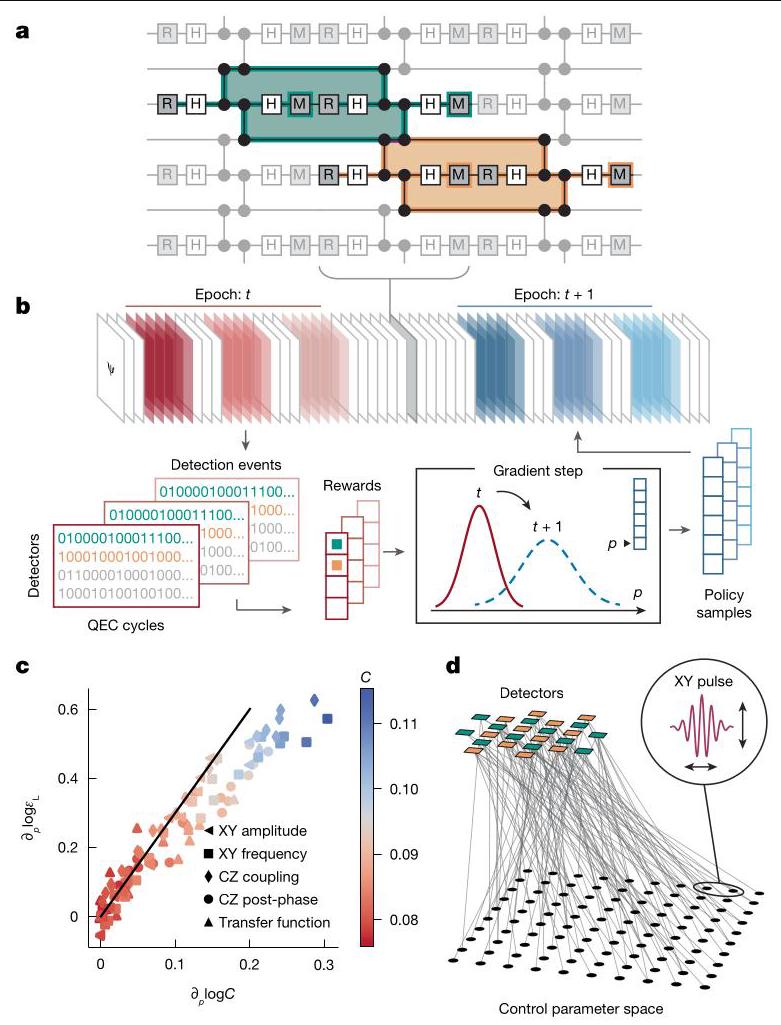
- 把 syndrome / detector stream 转换为 RL 奖励信号:稳定子测量中的 detection events 原本用于 decoder 推断逻辑修正;本文额外把 detection-event rate 用作控制学习的局部性能信号。
- 用 surrogate objective 代替直接优化 LER:直接估计 logical error rate 对 code distance 呈指数采样开销,且不能在未知逻辑态长算法中直接使用;本文用平均 detection-event rate 作为可实时估计的局部代理目标。
- 利用 QEC circuit locality 提升可扩展性:detector 只依赖其 detecting region 中的部分 gates / controls,因此可构造 detector-control factor graph;distance-5 surface code 中每个 detector 平均连接 302 个参数,每个参数平均连接 18 个 detectors。
- 在 Willow 上管理千级控制参数:RL agent 调整把抽象 QEC circuit 编译成模拟波形的控制参数,覆盖 CZ coupling strength、XY pulse amplitude / frequency 等可漂移控制量。
- 实验证明对 drift 有稳定化效果:对 injected drift,RL steering 使 LER 平均降低 24%,稳定性提升 2.4 倍;加入 decoder steering 后分别提升到 31% 和 3.5 倍。
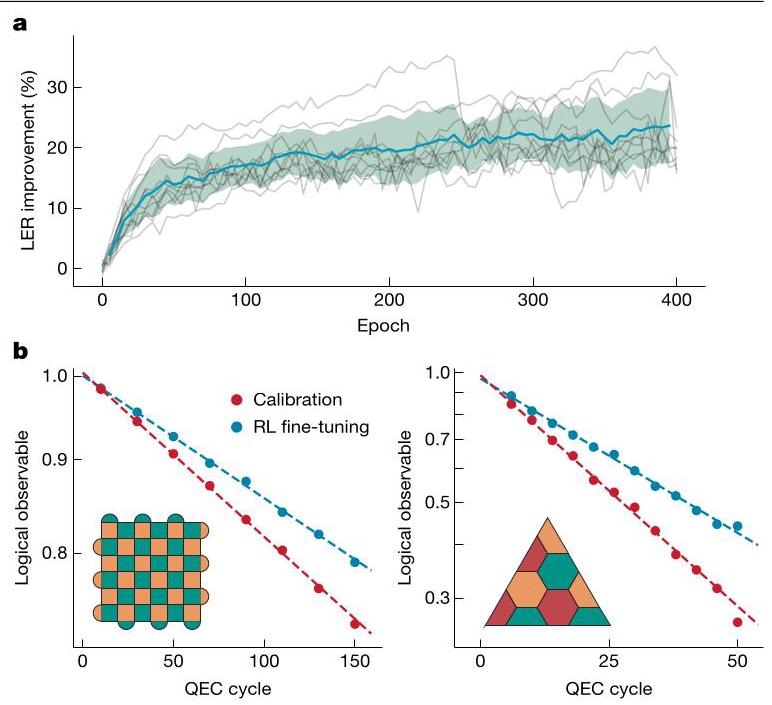
- 刷新 QEC 性能样本:经 RL fine-tuning 后,distance-7 surface code 的 average logical error per cycle 为 ,distance-5 colour code 为 ;well-calibrated processor 上还能再给出约 20% LER suppression。
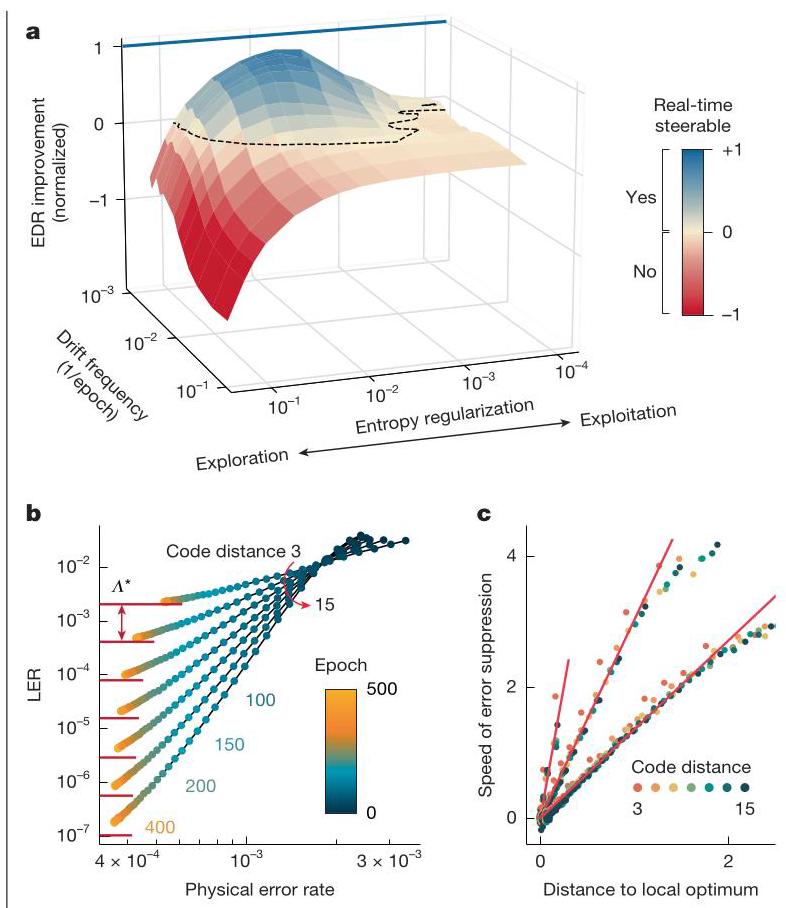
- 用大规模仿真检验 scaling:distance-15 surface-code 仿真包含约 40,000 个控制参数,结果显示接近局部最优的 convergence rate 与系统尺寸无关,主要由每个 detecting region 的 gate 数和每个 gate 的控制参数数目决定。
控制框架
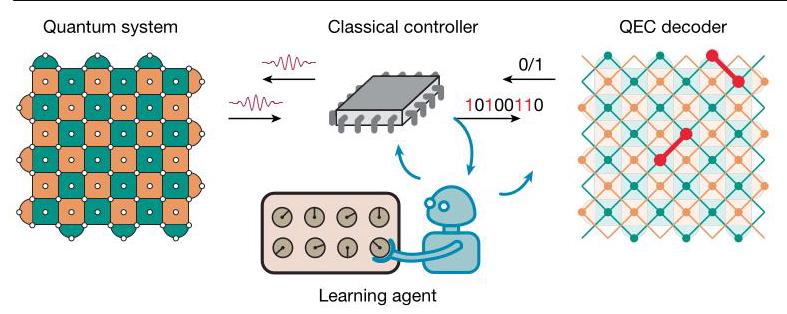
本文的关键工程结构是把 QEC 循环中的二值检测事件转成连续控制系统可用的反馈:
- 控制器保存 gate control parameters;
- pulse compiler 把抽象 QEC circuit 映射成模拟控制波形;
- 在 QEC 运行中对所有控制参数施加小的同步扰动,探索控制空间;
- 每个 policy candidate 运行一定数量的 QEC cycles;
- 用 detectors 的 error-detection rate 估计 surrogate objective;
- policy-gradient RL 更新 factorized multivariate Gaussian policy distribution 的均值和方差;
- 在非平稳漂移下,均值跟踪最优控制策略,方差保持有限探索。
这里的 agent 不是写实验脚本的 LLM,而是一个面向高维连续控制参数的 RL controller。它和 LLM实验控制代理 都属于实验自动化,但控制对象不同:LLM agent 生成和调度实验流程,RL agent 在 QEC 运行时持续调参。
实验结果与指标
| 维度 | 结果 | 工程含义 |
|---|---|---|
| Fine-tuning | 已充分传统校准后仍约 20% LER suppression | model-free in-context tuning 能补传统物理模型和人工调参遗漏的低概率误差通道 |
| Surface code | distance-7 average LER per cycle | 作为 superconducting surface-code quantum memory 的高性能样本 |
| Colour code | distance-5 average LER per cycle | 说明同一类 RL fine-tuning 可跨 code family 使用 |
| Injected drift | RL steering 降低 LER 24%,稳定性提升 2.4 倍 | 控制参数漂移可由 detection stream 在线追踪 |
| Decoder steering | 与 controller steering 组合后 LER 降低 31%,稳定性提升 3.5 倍 | 控制层和 decoder prior / graph weights 可协同 |
| Step response | XY pulse amplitude step drift 的响应时间约 130 epochs | 给出在线控制带宽量级;快于此的漂移需要硬件层处理 |
| Natural drift | 低频 LER fluctuation 约 4 dB suppression | 对真实材料缺陷、温漂、控制仪器漂移有稳定化作用 |
| Scaling simulation | distance-15、约 40,000 控制参数 | factor graph locality 让优化速度不随 code size 变慢 |
对本知识库的意义
- 对 量子实验自动化与安全控制:本文补上了“安全门控之外的运行中优化”维度。安全 gate 负责不越界,RL/QEC feedback 负责在合法控制空间内持续改善系统表现。
- 对 量子纠错实时控制:本文提供了一个清晰样本,即不要把 calibration 看成 QEC 外部的维护动作,而应把 QEC detector stream 视为长期运行控制面的实时传感器。
- 对 离子阱量子计算:论文平台是超导处理器,但作者明确声称框架只要求 error-detection signals 和 tunable controls,原则上适用于任意物理 qubit modality 与 QEC architecture。INFERRED:映射到离子阱时,可调参数会变成 Raman/激光频率、相位、脉冲面积、trap/RF、micromotion compensation、sideband cooling 和 readout threshold 等。
- 对长期量子节点工程:这类控制需要把 decoder、classical controller、pulse compiler、数据吞吐和参数权限管理放在同一控制平面内;它不直接处理远程纠缠,但对长时间运行的本地 processor / memory 节点有系统层启发。
限制与开放问题
- exploration noise:当前实验依赖重复短逻辑算法,每次 shot 可重新制备状态;真正长算法中,采样较差 policy candidate 会直接伤害同一次逻辑计算。
- 控制带宽有限:仿真显示低频漂移可实时 steer;高频或突发漂移,例如超导器件中的高能粒子冲击,当前实现需要硬件层缓解。
- decoder steering 的可扩展性未完全解决:本文中的 decoder steering 依赖 LER estimation,不像 controller steering 的 detector-rate surrogate 那样直接适合实时场景。
- 代码不可公开:论文说明自定义代码为 Google proprietary;复现依赖 Methods 与补充材料中的数学描述。
- 安全边界仍需另行设计:RL controller 本身追求降低 detection-event rate,不等同于硬件安全系统;与 ARTIQ安全门控控制栈 类似的 bounds / authorization / audit 层仍然需要独立存在。INFERRED
与其他素材的关联
- 与 Hardware-Safety-Gated LLM ARTIQ Control:两者都把 AI/agent 引入实验控制,但前者侧重 LLM-written ARTIQ 脚本的硬件授权边界,本文侧重 QEC detector stream 驱动的在线连续控制。
- 与 离子阱量子计算:本库目前的离子阱量子计算页主要覆盖 Cirac-Zoller、normal modes 和自动化校准;本文提示未来还需补充 QEC-era runtime calibration。
- 与 远程纠缠与量子网络接口:本文不讨论远程纠缠或网络链路;只在“长期运行节点需要稳定控制面”层面有间接启发。
图片索引
- Fig. 1:RL control overview
- Fig. 2:Learning from errors / factor graph
- Fig. 3:RL fine-tuning QEC performance
- Fig. 4:RL steering under injected drift
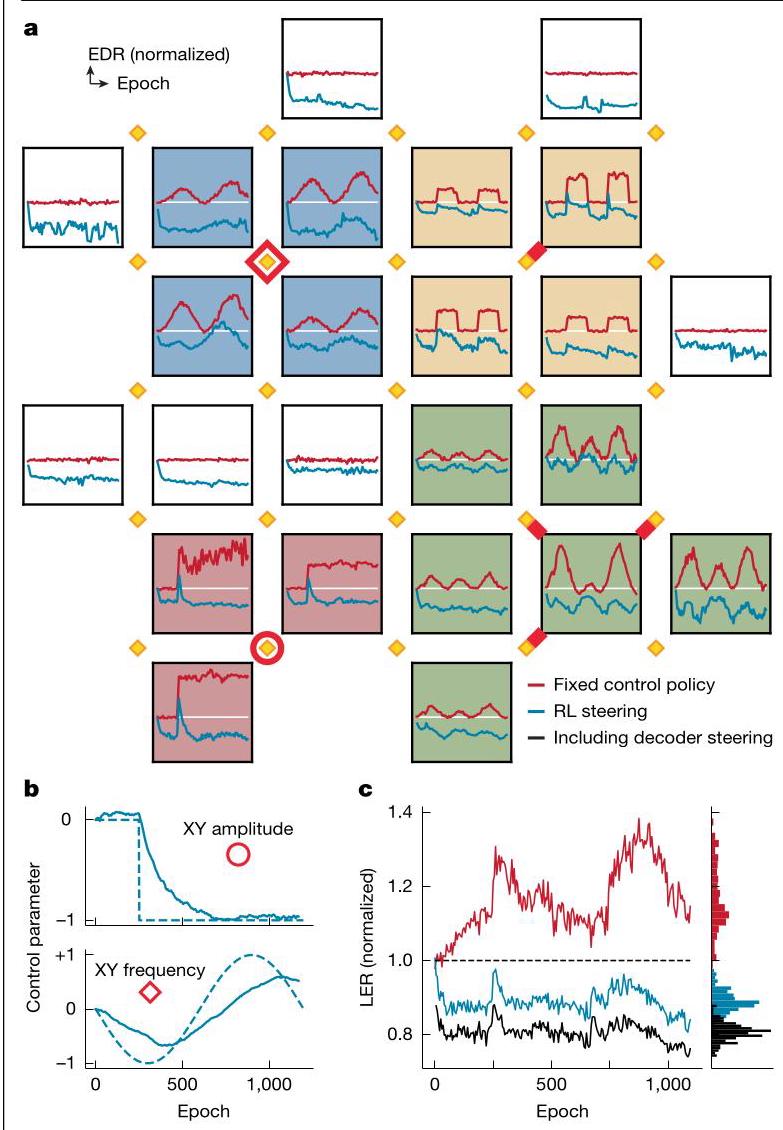
- Fig. 5:Real-time steering and scaling simulations