Smith 等人在两枚同位素 离子上,用静磁场产生的 Zeeman 频率分离和片上近场微波把 coolant 与 data qubit 的控制通道分开:16 个冷却周期把共享的 径向 rocking mode 从 冷却到 ,同时测得数据量子比特每周期总误差为 。
基本信息
- 题目:Microwave-driven same-species sympathetic cooling for trapped ions
- 作者:M. C. Smith、E. Vandrey、A. D. Leu、N. Drotleff、A. Agrawal、K. Miyanishi、D. M. Lucas、M. F. Gely
- 机构:University of Oxford;K. Miyanishi 同时属于 The University of Osaka
- 日期:2026-07-23
- 标识:arXiv:2607.20292v1
- 物理平台:室温 segmented surface-electrode Paul trap 中的一枚 data ion 与一枚 coolant ion,二者均为
- 核心控制:片上 microwave resonator、全局近场 MW、Zeeman 频率选择、resolved sideband cooling、detuned compensation tones、spin echo
- Doc2X Markdown:原文提取
- 原始 PDF:归档文件
- 消化日期:2026-07-24
本文数值按证据类型区分:
- MEASURED:本文装置直接测量或由本文测量拟合得到。
- SIMULATED / ESTIMATED:作者用原子分支比、数值模型或明确假设估算。
- AUTHOR-PROJECTED:作者把本次结果外推到未来运行条件,不是本装置已演示结果。
- INFERRED:本页基于论文信息给出的工程解释;来源页中仅在确有必要时使用。
这篇文章解决什么问题
离子阱量子门常把共享运动模当作 quantum bus。即使门方案不要求严格基态,门误差仍会随运动温度升高;表面电场噪声和 QCCD shuttling 又会持续给运动模加热。因此需要在不破坏 data qubit 电子态信息的前提下,周期性地用 ancillary coolant ion 移走共享运动中的声子。
传统异种离子协同冷却用较大的光学跃迁频差抑制 data ion 的非共振散射,但代价是:
- coolant 需要额外一套波长和激光基础设施;
- 质量失配会降低部分 normal mode 中 coolant 的 mode participation,甚至需要 indirect cooling;
- 双同位素方案减少质量失配,却仍可能因 isotope shift 较小而产生非共振散射;
- 同种同位素方案若把 data qubit 暂存到 metastable state,会引入 mapping pulse 与自然衰变风险。
本文选择更窄的设计空间:data 与 coolant 是同一同位素,量子信息保存在 ground-state manifold 内的 clock states 中;均匀静磁场产生较大的 Zeeman splitting,把 data 与 cooling transitions 在频域分开。冷却用全局近场 MW 驱动,只把 laser 用于 coolant 的重初始化,不需要用紧聚焦 laser 直接驱动 coolant sideband,也不需要把 data qubit 映射到 metastable state。
实验平台与频率架构
| 项目 | 本文配置 | 证据 |
|---|---|---|
| 离子 | 2 枚 ;1 data + 1 coolant | MEASURED |
| trap | 室温 segmented surface-electrode Paul trap | MEASURED |
| 离子高度 | trap surface 上方 | MEASURED |
| 静磁场 | MEASURED | |
| data qubit | $ | 4,1\rangle\leftrightarrow |
| coolant transition | $ | 4,2\rangle\leftrightarrow |
| 冷却运动模 | in-plane radial rocking mode, | MEASURED |
| sideband pulse | 每周期 | MEASURED |
| 完整冷却周期 | MEASURED | |
| 近场耦合 | on-chip MW resonator / waveguide | MEASURED |
“全局 MW”不等于整个实验不需要单离子区分。初态制备时,作者用 DC 电极旋转离子晶体,使两枚离子位于不同的近场 MW amplitude gradient 上,再用 composite pulses 完成 individual addressing。冷却 sideband 本身则依赖 data 与 coolant transitions 的频率选择性。
冷却与重初始化序列
1. 预冷却与态制备
- 两枚离子先做 dark-resonance Doppler cooling;由于该 trap 中双离子寿命约为 2 min,实验把两枚离子放在不同势阱中轮流移到中心冷却,再合并。
- 合并后先用 MW-enhanced optical pumping 把两枚离子制备到 。
- 用 MW transfer pulses 把两枚离子转到 。
- 用 crystal rotation + MW amplitude-gradient addressing 把 data ion 转到 ,coolant 暂留在 。
- 再用 MW pulses 把 coolant 转到 ,把 data ion 放回 。
2. 移除一个运动量子
coolant 初态为 。一个 MW pulse 驱动 的 red motional sideband;转移到 的 population 与从共享运动模中移除能量相对应。
3. 重初始化 coolant
sideband pulse 后,作者先用 MW pulses 把:
- 已完成冷却转移的 population 从 搬到 ;
- 仍留在 的 population 搬到 。
随后执行两次 recombination / repumping:
- 、 的 pulse 把 搬到 。
- 在这部分 population 位于 metastable state 时,用 MW pulse 把 搬到 。
- 、 pulse 经 把 metastable population repump 回 ground manifold,并发射 photon。
- 再交换 与 并重复上述过程,以减小不完美 pulse 留下的 population。
- 末尾加 、 pulse,清空掉入 manifold 的 population。
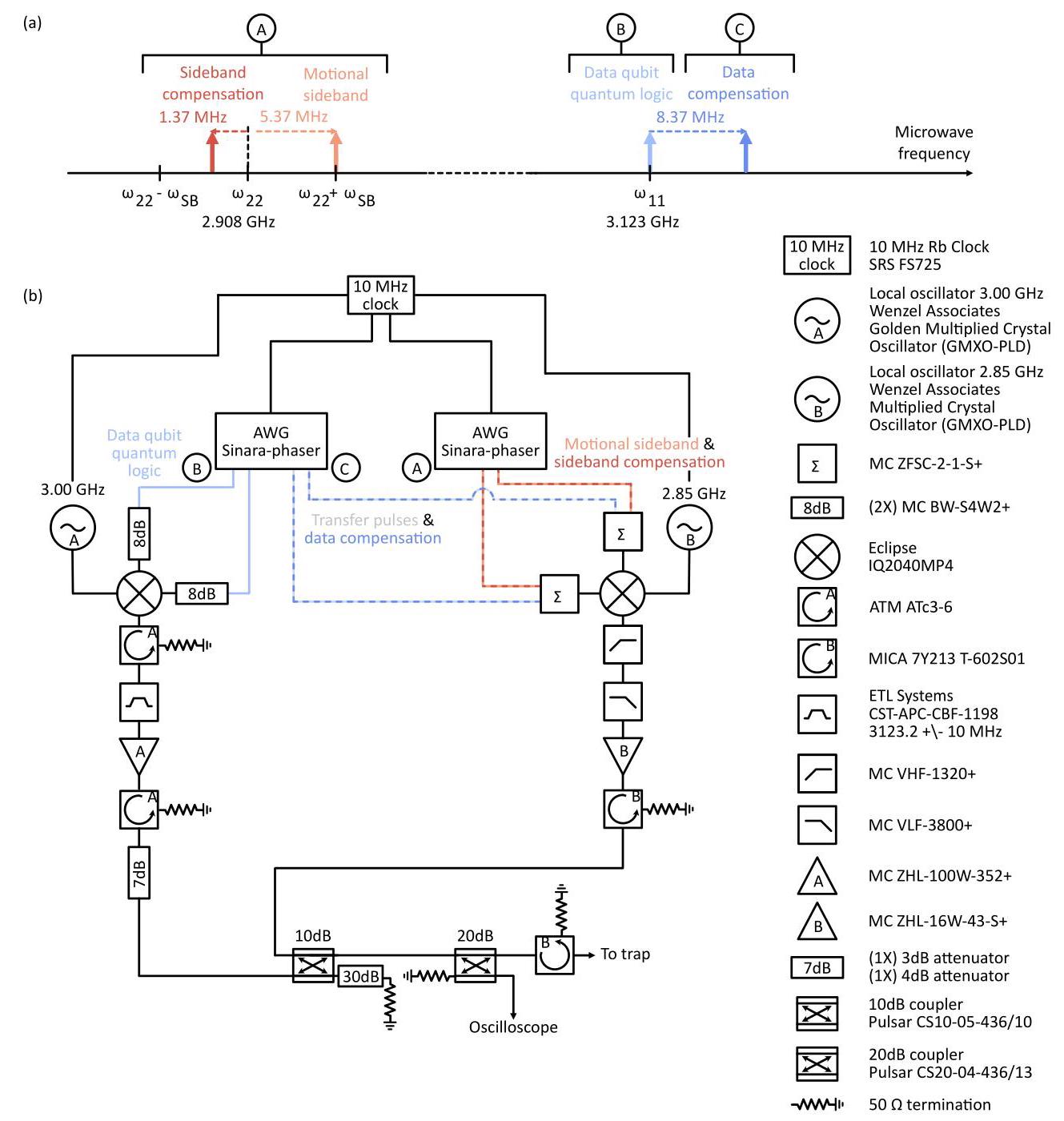
三音 MW sideband 控制
在 sideband pulse 期间同时施加三种 MW tones:
| tone | 频率位置 | 作用 |
|---|---|---|
| motional sideband | 驱动 coolant transition 的目标运动边带 | |
| sideband compensation | coolant transition 下方 | 抵消 sideband tone 在 coolant transition 上产生的 ac Zeeman shift 与共模幅度漂移 |
| data compensation | data transition 上方 | 抵消前两种 tones 在 data qubit 上产生的 ac Zeeman shift |
三种 tones 由同一宽带 MW drive 链生成,使热漂移和技术幅度噪声尽量共模,再通过 opposite-sign ac Zeeman shift 相消。独立的 MW chain 驱动 data-qubit logic;transfer pulses 覆盖约 –。
冷却性能
| 指标 | 结果 | 证据 |
|---|---|---|
| Doppler + state preparation 后初始 occupation | MEASURED | |
| 16 个周期后最低 occupation | MEASURED | |
| 时每周期降温量 | quanta/cycle | MEASURED |
| 等效冷却速率 | quanta/s | MEASURED |
| mode heating rate | quanta/s | MEASURED |
| sideband linewidth | MEASURED |
平均声子数由 Raman laser 扫描 的 red / blue sidebands,并对两者 jointly fit 得到。 是本文在该模式、该脉冲序列与 16 个周期下测得的最低 occupation,不应解释成这个机制的基本极限。
数据量子比特保护
频移补偿
sideband 与 sideband-compensation tones 对 data transition 造成约 ac Zeeman shift。data-compensation tone 抵消大部分 shift,但受相对 MW amplitudes 热漂移和标定精度限制,仍残留约 波动。
短 MW transfer pulses 还会给 data qubit 带来约 – shifts。作者把 cooling cycles 成对执行,并在周期之间加入 data-qubit spin echo;SK1 composite pulses 则降低热瞬态引起的 pulse-amplitude error。
IRB 误差预算
| 项目 | 每 cooling cycle 的 data-qubit error | 证据 |
|---|---|---|
| 完整 sympathetic-cooling cycle | MEASURED,IRB | |
| 等时长 idle | MEASURED,IRB | |
| 冷却相对 idle 的额外误差 | MEASURED,由两项相减 | |
| sideband pulse + compensation | MEASURED,IRB | |
| MW transfer pulses | MEASURED,IRB | |
| laser repumping pulses | MEASURED,与等时长 idle 不可区分 | |
| 不使用 spin echo 的完整周期 | MEASURED,IRB |
IRB 把两个 cooling cycles 插在每个 single-qubit Clifford gate 后。多数长序列数据为了提高 trap lifetime 只用一枚 data ion 测量;作者再用双离子配置对较短 gate sequences 做验证。因此, 是本文对冷却序列影响的最佳 benchmark,但不是完整双离子长时运行或两比特门序列的直接演示。
主导限制:MW 热瞬态与频率漂移
本文最重要的工程结果不是存在某个固定 ac Zeeman shift,而是高功率 MW pulse 造成的 shift 会随时间变化:
- pulse 内漂移:约 的 coolant-transition ac Zeeman shift 在 内变化约 ,已经大于 sideband linewidth。跟踪同一 MW drive amplitude 的 sideband-compensation tone 用来做共模抵消。
- pulse-to-pulse 漂移:连续 cooling cycles 中 sideband frequency 逐渐变化约 ,约 10 个 pulses 后趋于饱和。实验在 state preparation 后加 warmup sideband pulse,使 MW chain 先进入近稳态。
- 长时间漂移:约每 15 min 插入的 mode-frequency calibration 显示相邻测量之间有 half-width-half-maximum 变化。作者因此使用比理论最优 pulse 更短的 sideband pulse,以牺牲部分峰值冷却效率换取 detuning robustness。
作者把这些漂移至少部分归因于约 MW sideband drive 在室温 drive chain / on-chip resonator 中造成的 thermal transients。room-temperature chip 的较高电阻率和 sapphire substrate 的较低热导使问题更明显。
coolant 重初始化与人口泄漏
repumping 不是完美 closed loop:
- 从 衰变时约 93% population 回到目标 ,约 6% 回到 ,约 1% 进入 。
- 轴向 mode 的 heating rate 为 quanta/s; beam 在轴向有投影,因此作者估计 20 个 cooling cycles 后该 pulse fidelity 降至约 93%。
- SIMULATED:用 Atomic Physics project 模拟,在每周期执行两次 repumping 的情况下,20 个 cooling cycles 后约 population 未回到目标 state。
- AUTHOR-PROJECTED:若 cooling 与 logic gates 交替、每次都需从 的稳态移除相近能量,closed-loop population loss 可能约为每次应用 ;本文没有在该工作点做长期演示。
作者提出的改进包括:从主要泄漏态 增加回收 pulse;控制 polarization;增加 repumping repeats;选择对轴向 mode 无投影的 beam;或在 QCCD 中换入一枚已预先 state-prepared 的新 coolant ion。
作者给出的扩展判断
- AUTHOR-PROJECTED:按 quanta/s heating rate,维持 约需 cooling cycles/s。
- AUTHOR-PROJECTED:结合本文测得的额外 cooling error 与作者引用的 electronically driven gate performance,cooling 对每个 two-qubit gate 的贡献约为 ;本文未实际在两比特门序列中测量这个数值。
- SIMULATED / ASSUMED:coolant repumping 发出的 photon 被 data ion 吸收所致误差估计为 /cycle;该模拟假设 ion separation 为 且 emission pattern 均匀。
- AUTHOR-PROJECTED:cryogenic operation 可降低电阻和 thermal transient,并且作者引用既有实验认为可把 ion-motion coupling 提高约 ;本论文没有在低温运行此冷却序列。
- 作者适用性声明:方案可推广到具有 metastable states 且 ground-state manifold 内至少有 4 个可用 states 的 ion species;本文只在 上验证。
transition 选择折中
把 coolant transition 放得更远离 data transition,理论上能减小 data-qubit ac Zeeman shift,但本文装置存在三项反向约束:
- on-chip resonator 以 data-qubit frequency 为中心,离中心越远需要越高 MW power;
- MW field gradient 随频率变化,离中心更远时 spin-motion coupling 变弱;
- 更远离 clock transition 的 Zeeman states 对磁场噪声更敏感,coherence time 可能低于约 ,不利于 sideband pulse。
作者也讨论用 quadrupole sideband 取代 MW sideband,以避开高 MW power 的热漂移;代价是需要高功率、稳定且更难片上集成的 quadrupole laser。本文的设计原则是尽量让 sideband cooling 与 entangling logic 复用同一控制技术。
与现有素材的关联
- 1997-Quantum-dynamics-of-cold-trapped-ions-with-application-to-quantum-computation 给出 shared normal modes、sideband coupling 与 motion bus 的理论底座;本文把“运动模必须足够冷”推进到运行中维护和 data-qubit error benchmark。
- 2016-Electromagnetically-induced-transparency-ground-state-cooling-of-long-ion-strings 用光学 EIT 一次覆盖长链多径向模;本文则用一枚 spectrally selected coolant ion 对一个共享 gate mode 做可插入逻辑序列的 pulsed sideband maintenance。二者的目标和散射路径不同。
- 2026-Remote-entanglement-need-not-be-the-bottleneck-for-modular-trapped-ion-quantum-computing 把 sympathetic cooling 作为 QCCD buffer 的可选步骤,但没有给出 data-ion coherence budget;本文直接测量了同种离子冷却对 data qubit 的单周期误差。
证据边界
- 本文直接演示的是两枚 和一个 in-plane radial rocking mode,不是长离子链多模并行冷却。
- 近基态 occupation 与冷却速率是双离子实验的直接测量;IRB 长序列多数在单离子配置完成,只以较短序列在双离子配置验证。
- 论文没有把该冷却序列插入完整两比特门或容错算法并测量 end-to-end logical performance。
- scattering floor、repump-loop leakage、每 gate 约 的贡献和 cryogenic 改善幅度均为模拟、假设或作者外推,不应与本文测得的 /cycle 混为一谈。
- 方案“不需要紧聚焦 laser”指 cooling sideband 的选择;本实验仍使用 laser 做 Doppler cooling、shelving、thermometry 和 coolant repumping,并在初态制备中用 MW amplitude-gradient addressing 区分两枚离子。
- 本文提到 Duke University 的另一种 Zeeman-selective same-isotope sympathetic cooling 方案,但本页未独立精读 arXiv:2605.27577,因此不对两者优先权或性能作额外判断。
关键概念
图片索引
Figure 1:同种同位素 data / coolant 分工、surface trap 与能级方案
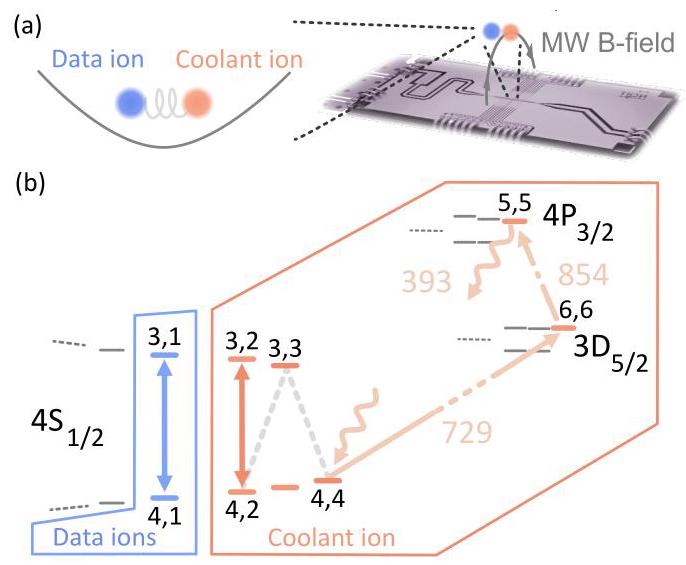
Figure 2:冷却周期数、red / blue sidebands 与平均声子数
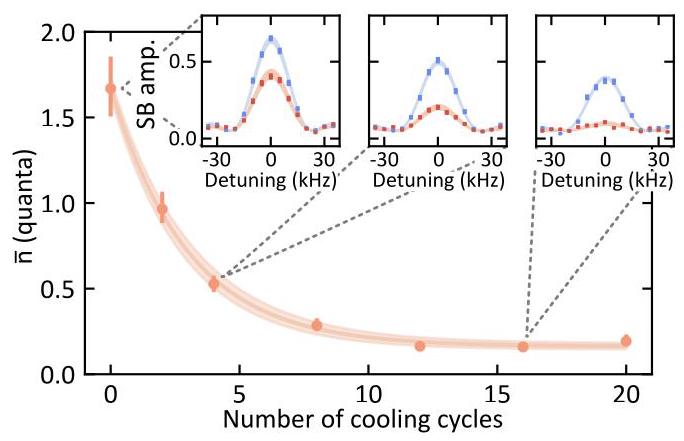
Figure 3:data-qubit IRB、compensation tone、spin echo 与 SK1 保护
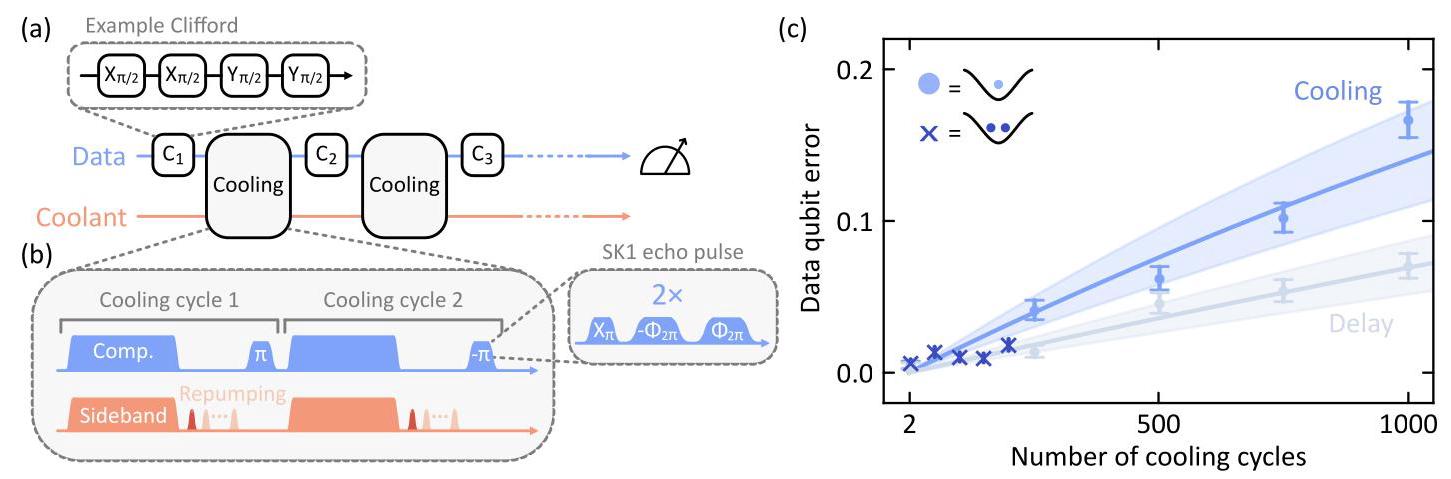
Figure S1:双离子分阱 / 合阱、态制备与逐离子读出时序

Figure S2:单个 sympathetic-cooling cycle 的 pulse-by-pulse 序列
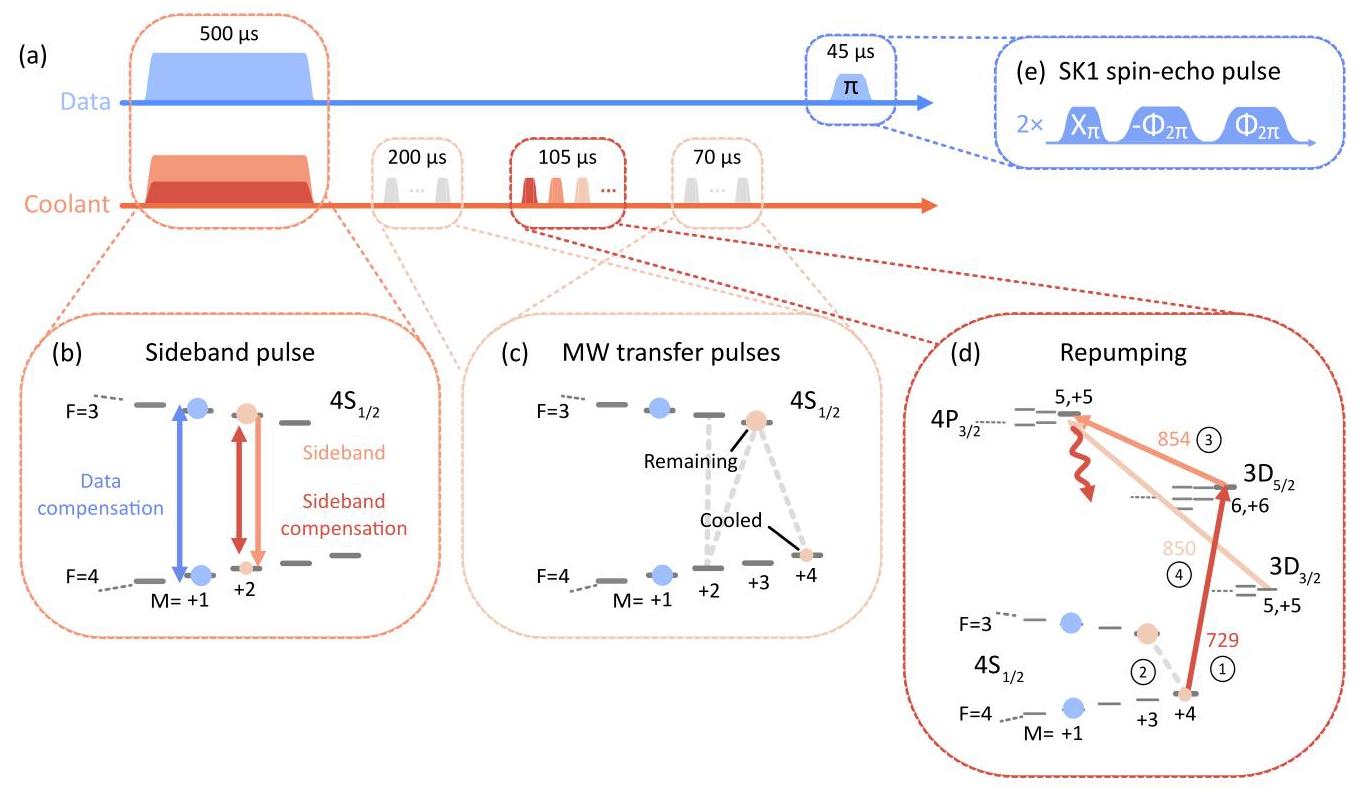
Figure S3:pulse 内 ac Zeeman shift 与 sideband-compensation tone
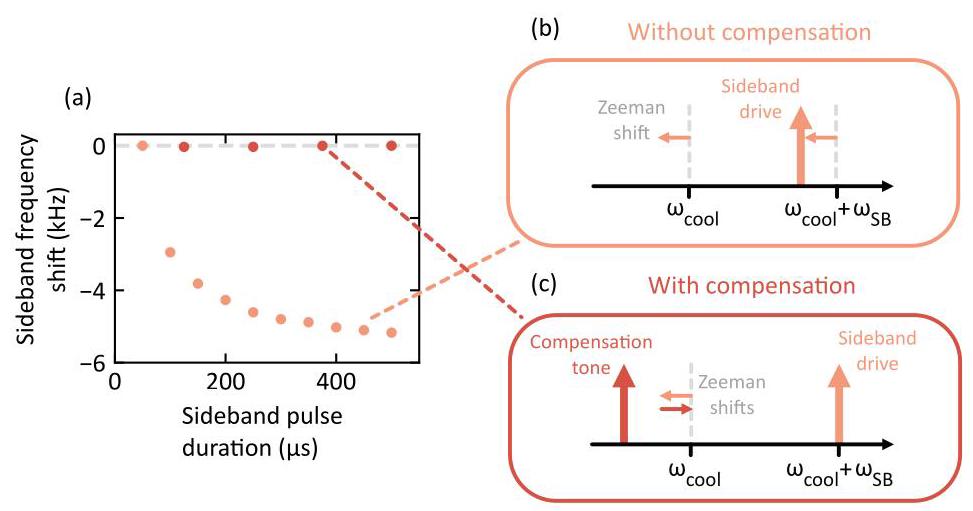
Figure S4:pulse-to-pulse frequency shift 与 warmup pulse
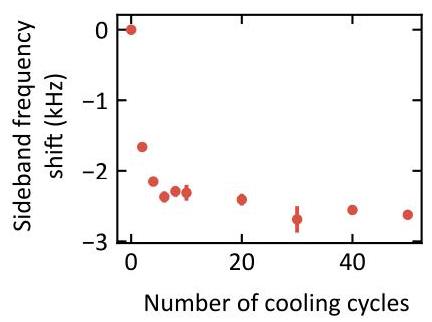
Figure S5:长时间 mode-frequency 漂移与 detuning simulation
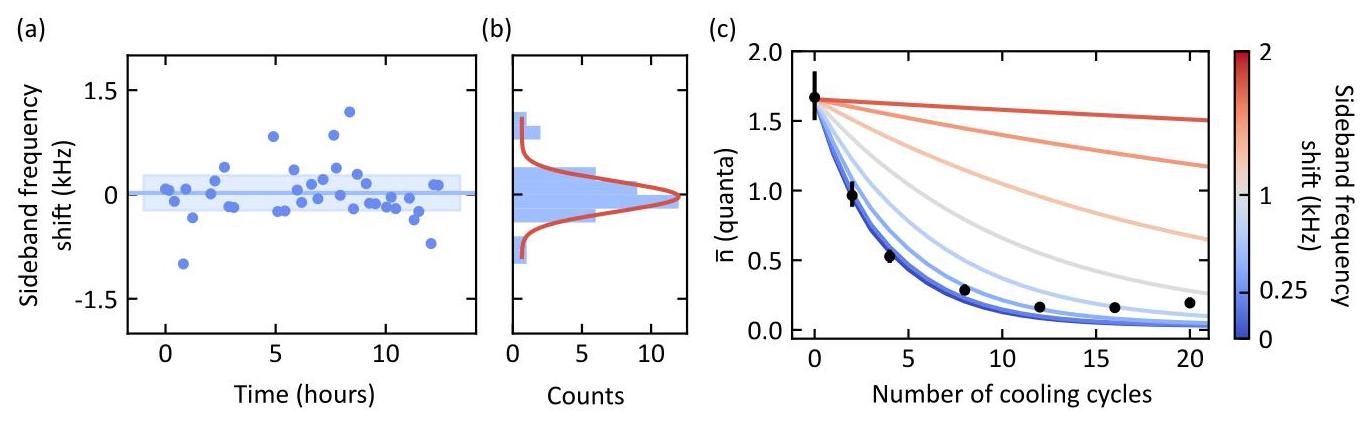
Figure S6:不完美 pulse 对冷却效率的模拟
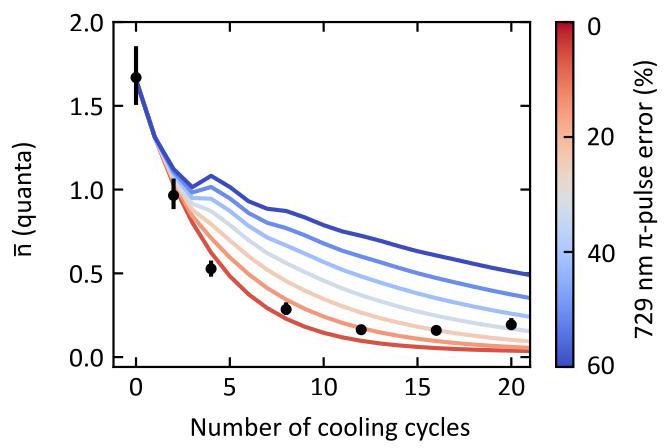
Figure S7:repumping closed loop、分支比与 population leakage 模拟
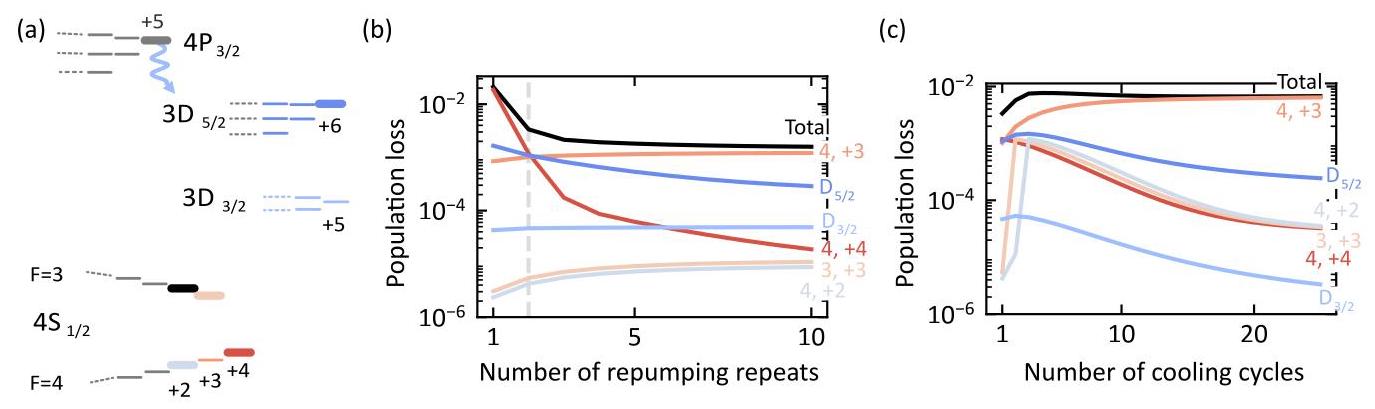
Figure S8:data-qubit protection 的 IRB 误差拆分
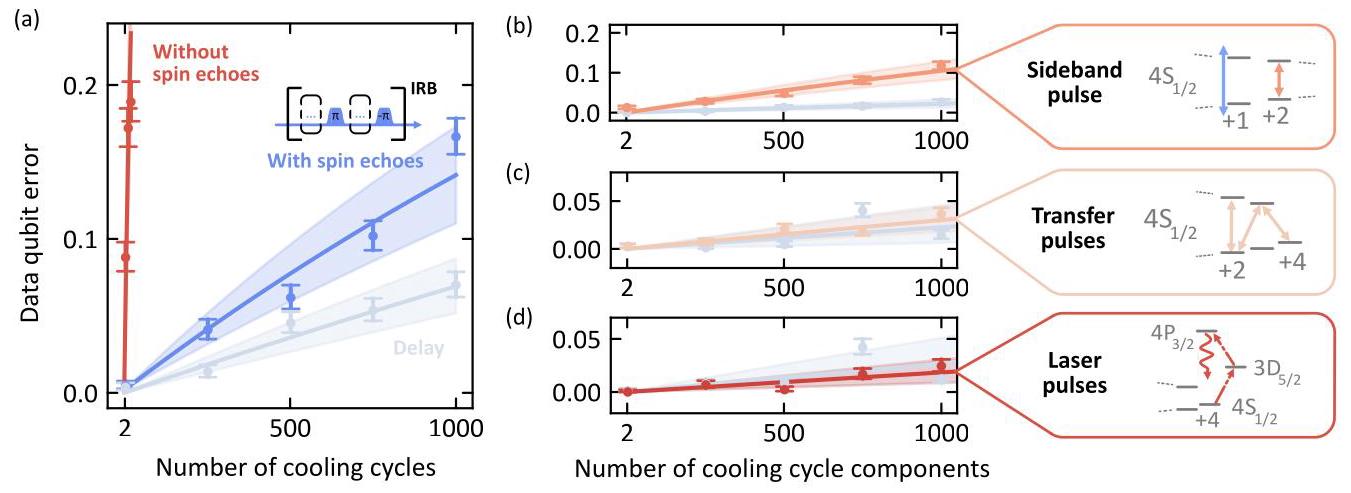
Figure S9:多音 MW pulse generation 与 drive chain
相关页面
- 同种离子协同冷却
- 离子链运动冷却
- 离子阱量子计算
- 离子链轴向normal modes
- Lamb-Dicke近似
- EIT冷却
- 介质诱导离子加热
- 1997-Quantum-dynamics-of-cold-trapped-ions-with-application-to-quantum-computation
- 2016-Electromagnetically-induced-transparency-ground-state-cooling-of-long-ion-strings
- 2026-Remote-entanglement-need-not-be-the-bottleneck-for-modular-trapped-ion-quantum-computing